BLOG | How to Select Validated Edtech Solutions Using Hattie’s Zone of Desired Effects
District leaders evaluating literacy programs face a version of the same problem every cycle: every vendor claims their product is evidence-based, and almost none of them define what that means. When budgets are tight and reading outcomes are on the line, "evidence-based" needs to mean something more precise than a testimonial and a case study.
John Hattie's Zone of Desired Effects gives district leaders a concrete benchmark for cutting through the noise.
What the Zone of Desired Effects actually is
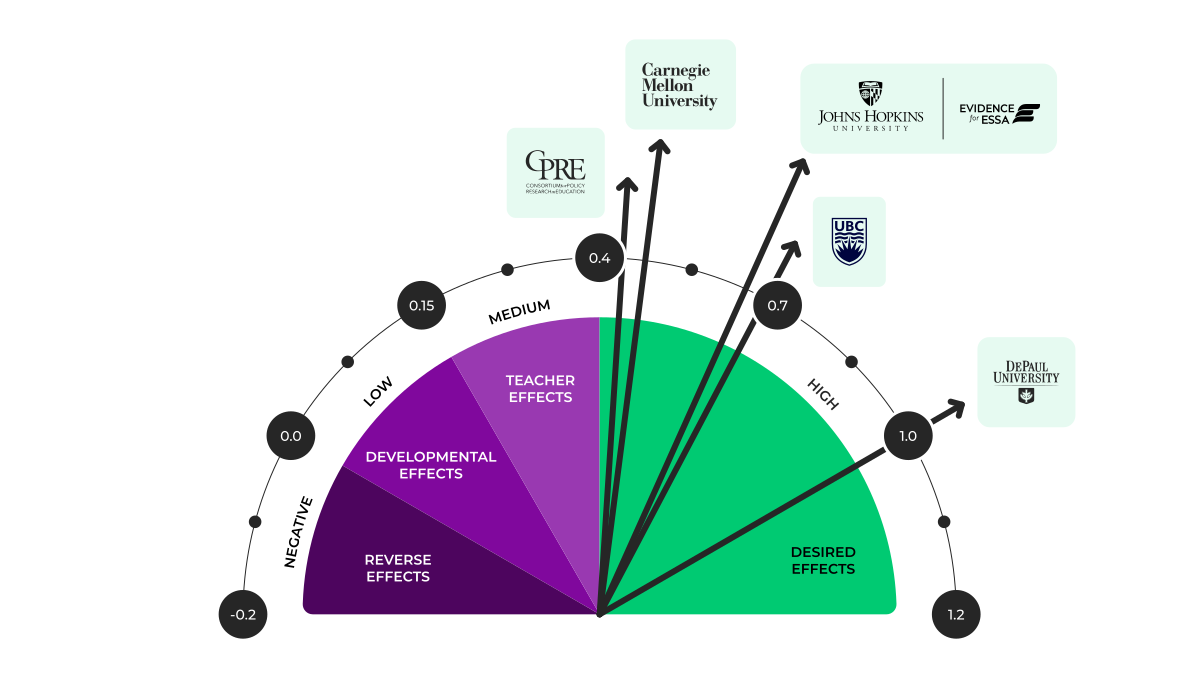
Hattie synthesized more than 800 meta-analyses of educational research to identify which interventions produce above-average student learning gains. The result was a standardized measure — effect size — that makes it possible to compare very different interventions on a common scale.
Here's how to read it:
- Effect sizes below 0.2 represent minimal impact on student achievement
- Effect sizes between 0.2 and 0.4 represent roughly what a year of typical teaching produces
- Effect sizes of 0.4 and above enter what Hattie calls the Zone of Desired Effects — interventions associated with accelerated, above-average learning gains
That 0.4 threshold is the practical benchmark for district leaders asking whether an edtech investment is likely to move the needle. An intervention that falls below it isn't necessarily worthless — implementation quality, student context, and alignment to local goals all matter — but it shouldn't carry the weight of a major budget commitment without a clear rationale.
Why this matters for edtech evaluation
The edtech market is full of products with "ESSA-aligned" or "research-backed" language on their websites. What's harder to find is independent, third-party research showing that a specific product produces effect sizes within Hattie's Zone — not internal white papers, not correlational data, not pilot results from a single school.
When evaluating any literacy program, the questions worth asking are:
- Is the evidence base independent, or produced by the vendor?
- Does the research show effect sizes at or above 0.4?
- Were results measured on a student population comparable to yours — by income level, English learner percentage, and grade level?
- Does the evidence meet ESSA Tier I or Tier II standards, which require experimental or quasi-experimental designs?
Most edtech products can't answer yes to all four. That gap is worth taking seriously before signing a contract.
Where Amira Learning's results sit
Amira Learning's AI reading platform has been validated by independent research at an effect size of 0.64 — well within the Zone of Desired Effects, and above the threshold associated with high-dosage human tutoring.
The evidence base behind that number includes an ESSA Tier II study conducted by Shah, Scanlan, and Wall for the Instructure EdTech Collective, examining 79,084 students across 12 Louisiana school districts — 75% economically disadvantaged, 10% English learners. Students using Amira showed statistically significant reading gains at every grade level from kindergarten through grade 5.
What produces those results is the coherence of Amira's model: assessment, instruction, and 1:1 AI tutoring unified in a single loop, built on more than 30 years of reading science and neuroscience research. Rather than adding another tool to a fragmented literacy stack, Amira functions as connective tissue — aligning screening data, instructional decisions, and tutoring support around a district's existing curriculum.
For district leaders trying to justify edtech spend to a board or evaluate program effectiveness against tighter budgets, that combination — independent evidence, a meaningful effect size, and a population that reflects high-need districts — is what separates a defensible investment from a marketing claim.
What to ask before you buy
Hattie's framework is most useful as a filter, not a final answer. Before committing to any literacy intervention, ask:
- What is the documented effect size, and who measured it?
- Does the research meet ESSA Tier I or Tier II standards?
- Were results measured at the grade levels and student demographics that match your district?
- Can the vendor show you the full study methodology, not just the headline number?
Programs that can answer these questions clearly are in a different category than those that can't. Amira Learning's research is available in full — we'd rather district leaders read it carefully than take the summary on faith.
Learn more about Amira's evidence base and how it applies to your district's literacy goals.
Read more from the AI & The Reading Brain Blog



.avif)